
Larimer County Criminal Court Records
A criminal court record is the court case file that opens when charges are filed. In Larimer County, felony cases belong in District Court after filing, while misdemeanors and many traffic crimes are handled in County Court. Fort Collins Municipal Court handles city ordinance violations, municipal traffic, petty offenses, civil infractions, photo enforcement, and local misdemeanors. A criminal court record may show the complaint or information, advisement, bond conditions, motions, plea paperwork, disposition, sentencing order, probation terms, restitution, fines, costs, and review hearings.
The 8th Judicial District Attorney is the prosecutor for state criminal cases in Larimer and Jackson counties. The DA's public materials explain the court process, victim services, diversion, records requests, public defender links, and the role of probation and community corrections. Jail booking data can show arrest facts and listed charges, but the court record shows what was filed and what happened after filing.
The DA judicial-system source in the manifest explains how prosecutors, public defenders, probation, and the courts fit into Larimer County criminal cases.
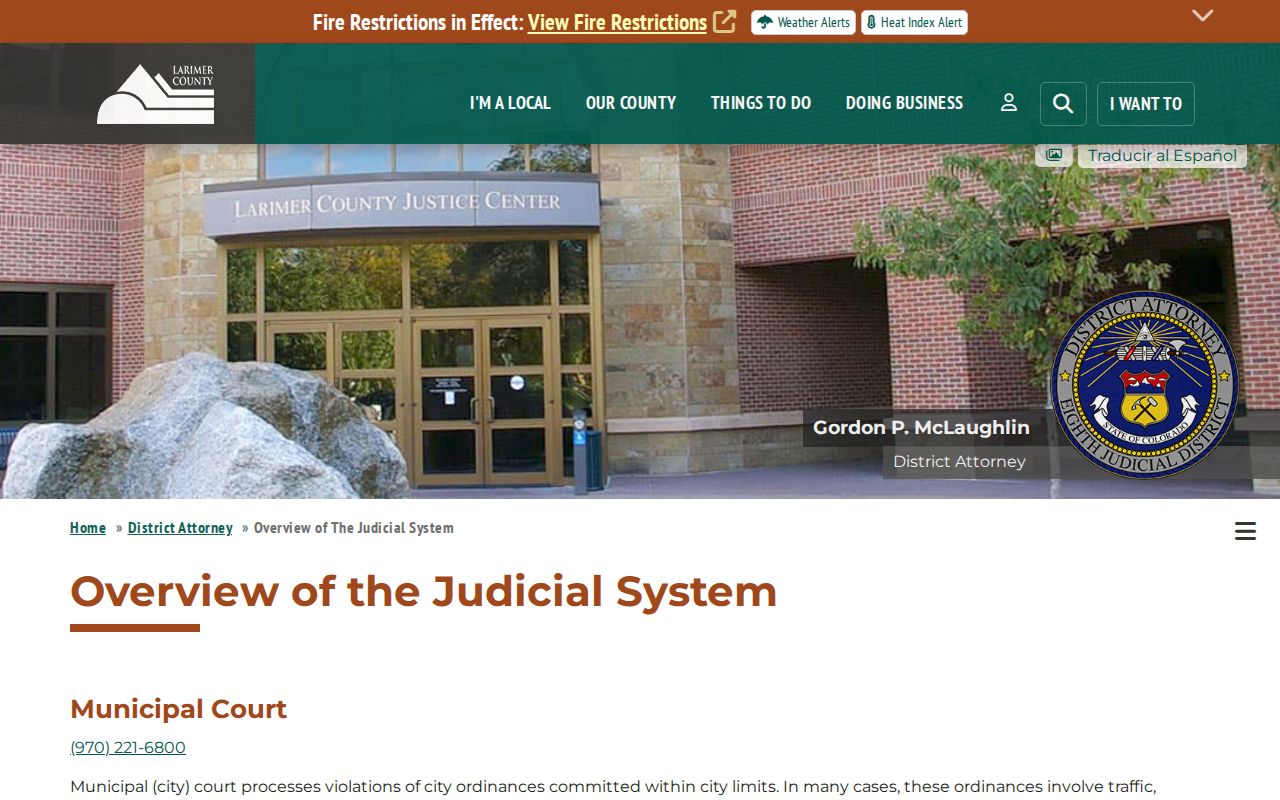
That office overview is useful context because criminal court records often include entries tied to DA filings, public defender appearances, probation, and diversion.
Search Larimer County Criminal Records
Start with the Colorado Judicial Branch docket search when checking a hearing date or case event for a Larimer District Court or County Court criminal matter. Use a date plus Larimer County, 8th Judicial District, courthouse, defendant name, case number, or attorney bar number. For full documents, use the statewide court record/document request form or the Larimer records email, 08RecordRequest@judicial.state.co.us.
- Decide whether the matter is a felony, misdemeanor, traffic crime, municipal citation, or warrant-related criminal case.
- Search the state docket for District Court or County Court cases using the date and a second filter.
- Save the case number, courthouse, hearing type, defendant spelling, and court location from the result.
- Request the complaint, information, disposition, sentencing order, mittimus, or certified copy from the Clerk of Court when needed.
- Use municipal court channels for Fort Collins city cases and jail or sheriff records channels for booking and law-enforcement records.
For a closer look at charge wording, amendments, and the arrest-to-charging path, use the Larimer arrest records and court charges page. For all civil, domestic, probate, traffic, and criminal case categories together, use the broader court records path.
The official 8th Judicial District Attorney source assigned to this page links to dockets, records requests, virtual courtrooms, victim services, diversion, and criminal justice programs.
The DA page is not the Clerk of Court, but it helps identify criminal-case services and prosecution-related records channels.
Larimer County Criminal Case Flow
Criminal court records are easiest to read as a sequence. A law-enforcement referral or arrest may come first, but the court file begins when charges are filed. The case then moves through advisement or arraignment, pretrial hearings, motions, plea negotiations, trial settings, plea or trial, disposition, sentencing, and post-sentence review when probation, restitution, collections, or warrants are involved.
Case flow: Charges Filed › Arraignment › Pretrial › Plea or Trial › Disposition › Sentencing
| Stage | What Happens |
|---|---|
| Charges filed | The prosecutor files a complaint or information in County Court or District Court. |
| Arraignment | The defendant is advised of charges and enters a plea or receives a setting. |
| Pretrial / motions | Attorneys file motions, request discovery, address bond, and prepare for plea or trial. |
| Plea or trial | The case resolves by plea, verdict, acquittal, dismissal, or other court action. |
| Disposition | The court records the outcome of the case or each charge. |
| Sentencing | The judge orders jail, prison, probation, fines, restitution, treatment, or other terms when applicable. |
The DA diversion source assigned to this page describes alternatives that may appear in a criminal case record as conditions, review hearings, dismissal paths, or sentencing considerations.
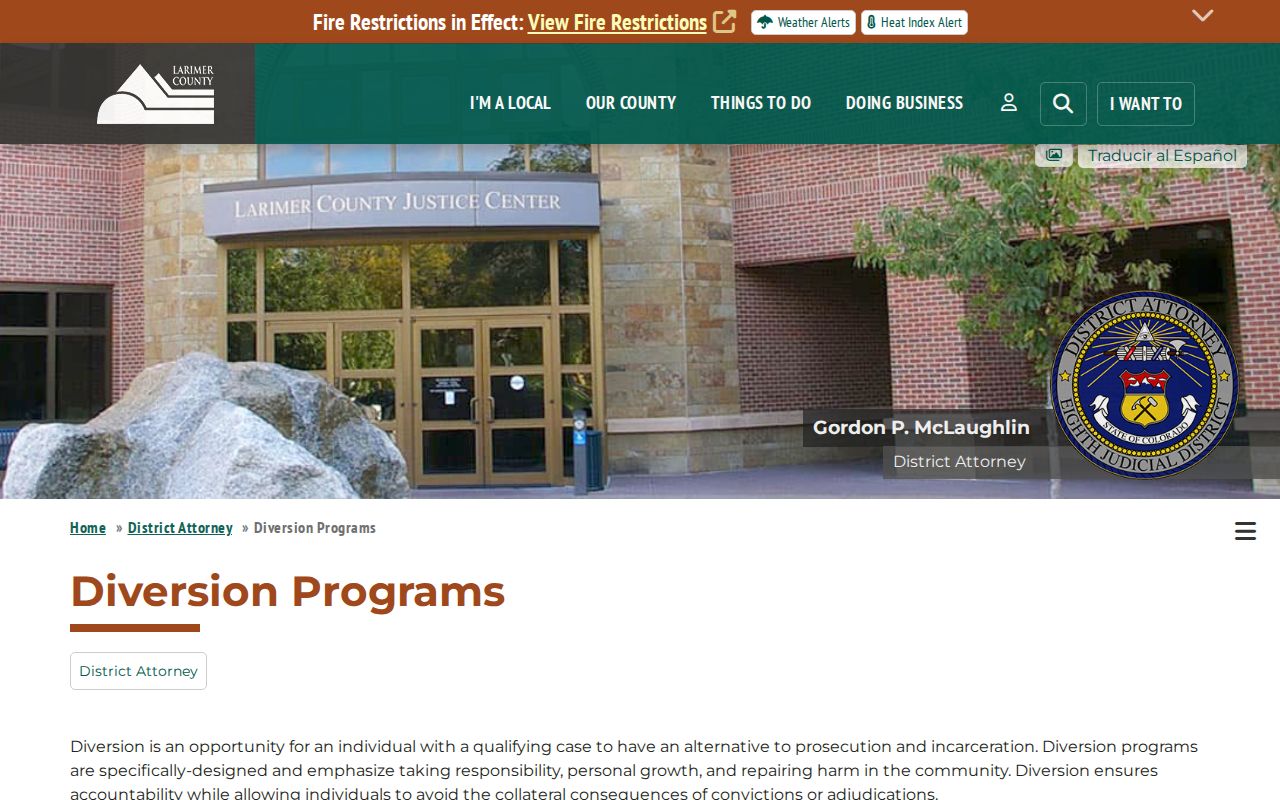
Diversion does not erase the need to check the court file, because eligibility, compliance, dismissal, and restitution can affect the record.
Larimer County Criminal Record Fields
A Larimer County criminal court record may contain public docket data and requestable documents. Some data appears online through docket search, while full filed papers may require the Clerk of Court. Juvenile matters, sealed cases, victim information, protected addresses, medical details, and confidential identifiers may be suppressed or redacted before release.
| Field | What It Shows |
|---|---|
| Case number | The court's unique identifier, often with year, case type, and sequence. |
| Defendant | The person charged, subject to suppression in juvenile or protected matters. |
| Court location | District Court, County Court, Loveland County Court, or municipal court as applicable. |
| Charges | Filed allegations, charge description, statute, severity, and later amendments when public. |
| Bond and warrant entries | Bond terms, warrant issued, warrant recalled, or custody-related docket events. |
| Pleas and motions | Guilty, not guilty, deferred, contested motions, orders, and hearing settings. |
| Disposition | Dismissed, guilty, not guilty, deferred judgment, acquittal, or other outcome. |
| Sentence | Jail, prison, probation, community corrections, restitution, fines, fees, treatment, or review terms. |
Discovery and DA records are separate from the court case file. The DA discovery page says requests are subject to the Criminal Justice Records Act and access is generally more limited while a case is open.
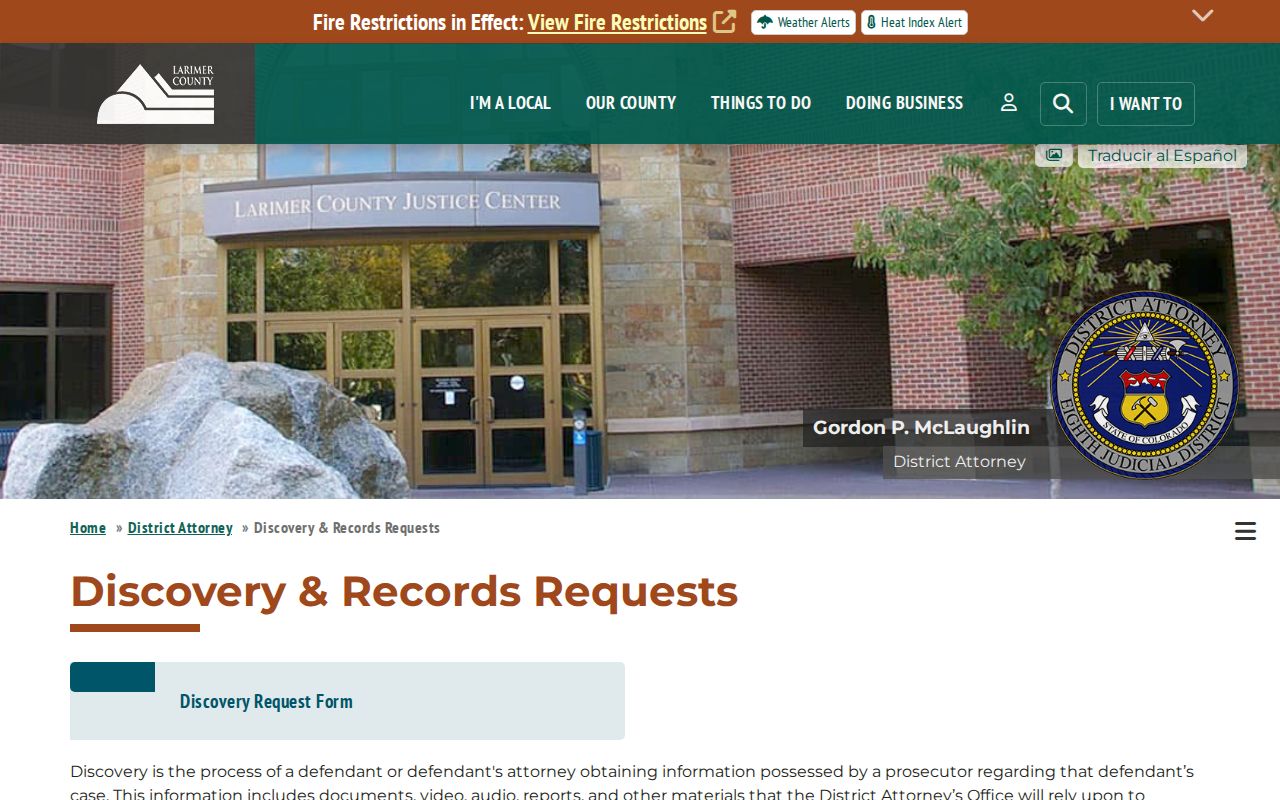
Use DA discovery channels for prosecution materials when allowed, and use the Clerk of Court for filed court documents and certified copies.
Larimer County Charges vs Convictions
A charge is an accusation filed in court. A conviction is an outcome after a guilty plea, verdict, or other qualifying court finding. Larimer County criminal court records can show charges that were amended, reduced, dismissed, deferred, or resolved without conviction. That is why a person reading a criminal file should check the disposition for each count instead of treating every charge as a final result.
| Charge | Conviction | |
|---|---|---|
| Meaning | An alleged offense filed by the prosecutor. | A final finding or plea that creates guilt for the count. |
| Where it appears | Complaint, information, docket, jail profile, and early hearings. | Disposition, judgment, sentencing order, mittimus, or probation terms. |
| Can change | May be amended, reduced, or dismissed. | May later be sealed if eligible, but it remains an outcome unless changed by court order. |
| How to verify | Check filed charging documents and docket history. | Check disposition and sentence fields for each count. |
The public defender application source assigned to this page is relevant because counsel can affect plea, trial, diversion, and sentencing outcomes shown in the final criminal court record.
For eligible defendants, appointed counsel can help interpret the difference between pending charges and final convictions.
Larimer County Dispositions and Sentences
Disposition means the outcome of the case or charge. Common outcomes include guilty, not guilty, dismissed with prejudice, dismissed without prejudice, deferred judgment, acquittal, or plea to an amended count. Sentencing can include jail, prison, probation, community corrections, restitution, fines, costs, surcharges, treatment, useful public service, or review hearings. A sentence may also create later docket activity if probation is revoked, restitution is modified, a warrant issues, or collections are opened.
Larimer County has local community justice and alternatives-to-incarceration programs that can appear in the criminal court process. Research notes Wellness Court, AIIM, diversion, competency dockets, probation, and community corrections. These programs are not separate courts for record-custody purposes. Their hearings and orders remain tied to the underlying criminal case, though treatment, health, and confidential program details may be limited.
Larimer County Sealed Criminal Records
Colorado sealing and juvenile expungement are different record actions. Sealing generally hides eligible adult criminal records from ordinary public view while preserving access for courts, law enforcement, prosecutors, and certain authorized users. Juvenile expungement can remove or restrict eligible juvenile delinquency records under separate law and may be automatic or petition-based for some closed cases.
| Sealed | Expunged | |
|---|---|---|
| Main use | Eligible adult criminal records and some arrest or case outcomes. | Commonly tied to eligible juvenile delinquency records. |
| Public view | Hidden from ordinary public searches after a court order or qualifying process. | Removed or treated as restricted under juvenile expungement rules. |
| Record existence | The record still exists for authorized access. | Access is more restricted, but specific agencies may retain allowed records. |
| Starting point | Use the Colorado Judicial Branch seal-my-case materials and the court that handled the case. | Review juvenile expungement rules and court forms for the case type. |
Note: Sealing a Larimer County criminal record limits public access, but it does not always erase agency access.
Larimer County Criminal Record Access
Public access to criminal court records comes from Colorado court-record rules, Chief Justice Directive 05-01, P.A.I.R.R., and the practical authority of the Clerk of Court to restrict protected files. Criminal justice records held by law enforcement or prosecutors are requested through the Colorado Criminal Justice Records Act process, not through the court docket search. County administrative records use CORA channels.
The Fort Collins Public Defender source assigned to this page provides local defense contact information for Larimer County defendants who cannot afford private counsel.
The public defender office is not a records custodian, but it is a key local resource when a defendant needs help with an active criminal court case.
Restricted Larimer Criminal Records
Not every Larimer County criminal court record is open. Juvenile records are commonly restricted. Sealed criminal records are hidden from public view. Victim information, minors' names, protected addresses, Social Security numbers, tax IDs, financial accounts, medical information, competency records, and treatment details are redacted or withheld. Suppressed cases may not appear in ordinary search results at all.
If a record is missing, do not assume the case never existed. It may be sealed, juvenile, transferred, municipal, federal, older, paper-based, or held by another agency. If the issue is an active warrant, use the court handling the case and the proper warrant-resolution channel. If the issue is custody, check the Larimer jail search, VINE, Colorado DOC, or federal custody tools depending on where the person may be held.
Important: A public criminal court lookup should not be used for FCRA-regulated employment, credit, tenant, insurance, or similar screening.