
Larimer County Arrest Records
Larimer County arrest records begin on the law-enforcement side. A deputy, police officer, or other agency may arrest a person, book that person into the Larimer County Jail, and create custody data showing name, arrest date and time, arresting agency, agency case number, charge description, warrant or docket number, bond type, and bond amount. The Larimer inmate search is the public starting point for current custody data, while the inmate records page gives the jail roster details.
Court charges after arrest are different. The 8th Judicial District Attorney reviews the law-enforcement referral and decides what to file in District Court, County Court, or another court with jurisdiction. After filing, the charge appears in the court case record with events such as advisement, arraignment, bond hearing, plea, motion, dismissal, sentencing, or probation review. The criminal court records page is the better route for the full case file and final outcome; the charge path runs from arrest to filing and later status changes.
The Larimer County Sheriff announced 2026 arrest details after a child-predator operation that led to jail bookings and listed charges.
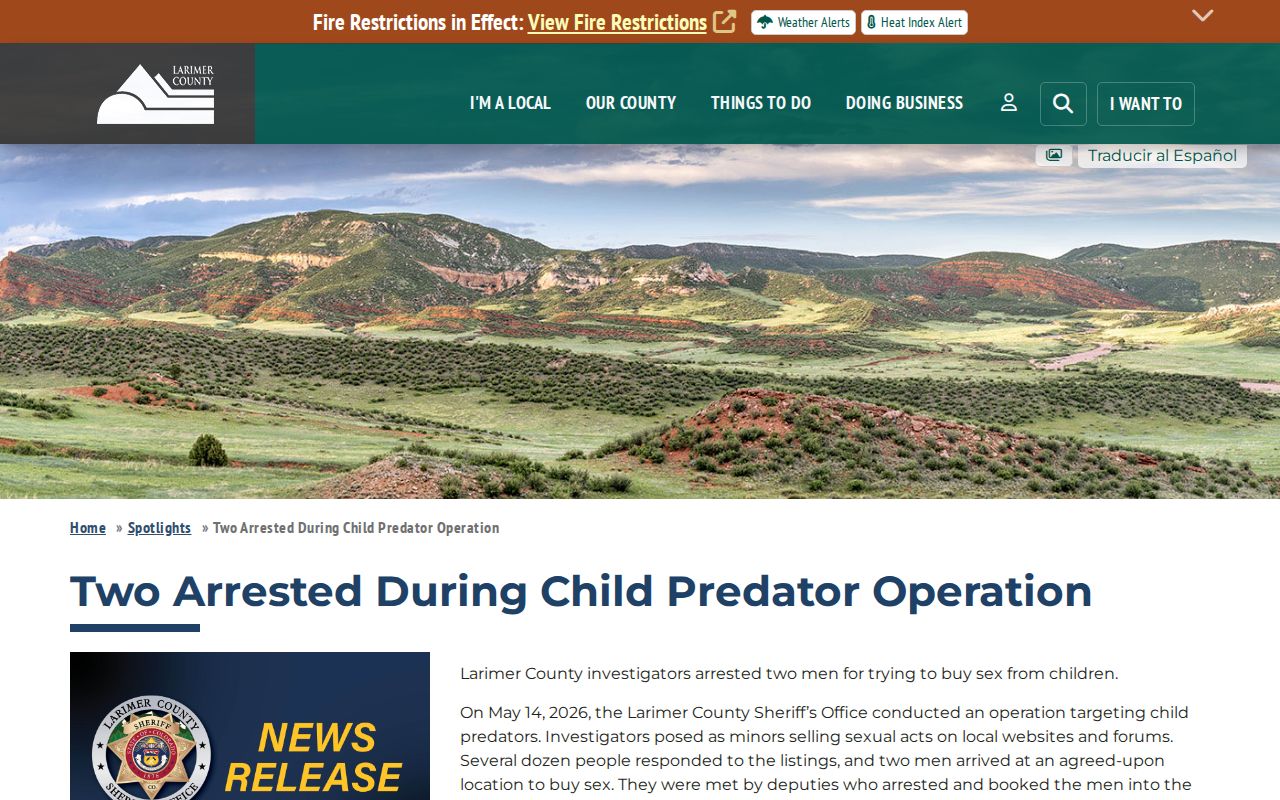
That kind of release shows why a booking or news item should be checked against the court case record before treating an accusation as a conviction.
Search Charges After Arrest
The best search path depends on the question. For custody, use the Larimer County Jail roster or call the jail. For the charge filed in court, use the Colorado Judicial Branch docket search for hearing information, then request documents from the Clerk of Court through the court record/document request form or 08RecordRequest@judicial.state.co.us. Court data services such as Colorado State Courts Data Access and CoCourts may show case data, but certified copies still come from the clerk.
- Start with custody status. Search the jail roster by last name if the arrest may be recent.
- Check the court level. Felonies are District Court matters, while misdemeanors and many traffic crimes are County Court matters.
- Use docket search for dates. Add Larimer County, 8th Judicial District, case number, party name, or courthouse to the required date search.
- Request the charging document. Ask for the complaint, information, disposition, sentencing order, or certified copy if needed.
- Confirm municipal cases separately. Fort Collins ordinance, petty offense, and municipal traffic charges may stay in Municipal Court.
Larimer County state trial-court case files are handled by the Clerk of Court through the Colorado Judicial Branch, not by the Larimer County Clerk and Recorder. The county Clerk and Recorder handles recorded documents and marriage records. For court charges after arrest, the practical public record chain is jail booking, DA filing, court docket, and clerk document request.
City arrests can add one more step. Fort Collins Police, Loveland Police, Estes Park Police, Timnath Police, Colorado State Patrol, or another agency may be listed as the arresting agency even when the booking occurs at the Larimer County Jail. The arresting agency case number is not always the same as the court case number. Use the jail profile for custody identifiers, then use the court docket or clerk request to confirm the filed charge.
Charging Documents in Larimer County
A charge record starts when a formal accusation is filed. The document name can matter because it shows who started the prosecution and what level of review occurred before the case moved forward. Colorado criminal records may use complaints, informations, and other filed documents depending on court level and case type. A complaint can start a criminal case. An information is a prosecutor-filed charging paper. An indictment is tied to grand-jury action and is less common than ordinary complaint or information practice.
| Document | Filed by | What it usually means | Larimer record use |
|---|---|---|---|
| Complaint | Law enforcement or prosecutor | Starts or states alleged offenses | Common in misdemeanor, traffic, and early criminal filings |
| Information | District Attorney | Formal prosecutor charge | Often central in felony District Court prosecution |
| Indictment | Grand jury | Grand-jury accusation | Used only when the prosecution proceeds through that route |
The 8th Judicial District Attorney serves Larimer and Jackson counties. DA records and discovery requests are governed by Colorado criminal-justice records rules, and access can be narrower while a case is open. The DA discovery page notes that criminal justice records and discovery are not the same as a public court docket.
Larimer Charge Status
Charge status can change several times. One arrest can produce several counts, and each count may move on its own path. A prosecutor may amend a charge after more review, reduce a charge as part of a plea, dismiss a count, add a related count, or proceed to sentencing after conviction. The public docket may show events, but a clerk document request is often needed to see the exact filed language.
| Status | Meaning | What to confirm |
|---|---|---|
| Pending | The charge is filed and not yet resolved. | Next hearing, bond terms, and active motions |
| Amended | The filed charge changed from an earlier version. | Original count, new count, and date of amendment |
| Reduced | The charge was lowered in severity or changed by plea agreement. | Final plea charge and sentencing basis |
| Dismissed | The court or prosecutor ended that count. | Whether the whole case or only one count was dismissed |
| Sentenced | A conviction or plea led to a sentence. | Mittimus, probation terms, restitution, and jail or prison credit |
The DA prosecution awards notice reflects how charge work can involve felony prosecution, task-force cases, and sentencing outcomes.
DA public information can add context, but the court file remains the source for a filed charge, plea, dismissal, sentence, and case disposition.
Charges Versus Convictions
A filed charge is an accusation. A conviction is an outcome reached by guilty plea, no-contest plea where allowed, or trial verdict. Larimer County arrest records and court charge records can be public even when a person has not been convicted. That distinction matters for background checks, housing decisions, job decisions, and personal research. A charge may be pending, dismissed, amended, or sealed later.
| Point | Charge | Conviction |
|---|---|---|
| Record stage | Alleged offense after arrest or filing | Final finding or plea on an offense |
| Proof level | Based on filing standard and probable cause | Based on plea or proof beyond a reasonable doubt |
| Can change | May be amended, reduced, or dismissed | May still be appealed, sealed, or corrected by court order |
| Where verified | Charging document and docket | Disposition, sentencing order, mittimus, or judgment |
Colorado court records are subject to Chief Justice Directive 05-01 and the public access rules described by the Colorado Judicial Branch access guide. Criminal justice agency records may fall under C.R.S. section 24-72-301 et seq., while county administrative records use CORA. Juvenile, sealed, suppressed, mental-health, victim, and protected-address details may be withheld or redacted.
DA discovery is another separate channel. Discovery may include police reports, body-camera material, witness information, or other criminal justice records that are not part of the public court docket. The District Attorney's discovery process can be limited by case status, party role, victim protections, and criminal justice records law. A public case number does not guarantee access to all prosecution materials.
For a clean record check, compare three facts: the jail booking charge, the prosecutor's filed count, and the court disposition. If those facts differ, the latest filed court order controls the legal outcome.
This is also why a person should not treat an arrest headline, booking entry, or charge list as the end of the case. Larimer County court records can later show dismissal, deferred judgment, sentence modification, probation review, restitution, or sealing activity.
Warrants and Bond Entries
Booking and court records can both contain warrant or bond data. The jail profile may show warrant or docket number, bond type, and bond amount after a person is booked. The court case may show a warrant issued, warrant recalled, bond hearing, bond modification, failure to appear, or bond forfeiture. A warrant entry does not prove guilt. It shows that a court order or law-enforcement process affected custody or appearance.
The 2026 hit-and-run arrest notice describes investigators presenting facts to a judge and obtaining a warrant before the suspect was booked into Larimer County Jail.
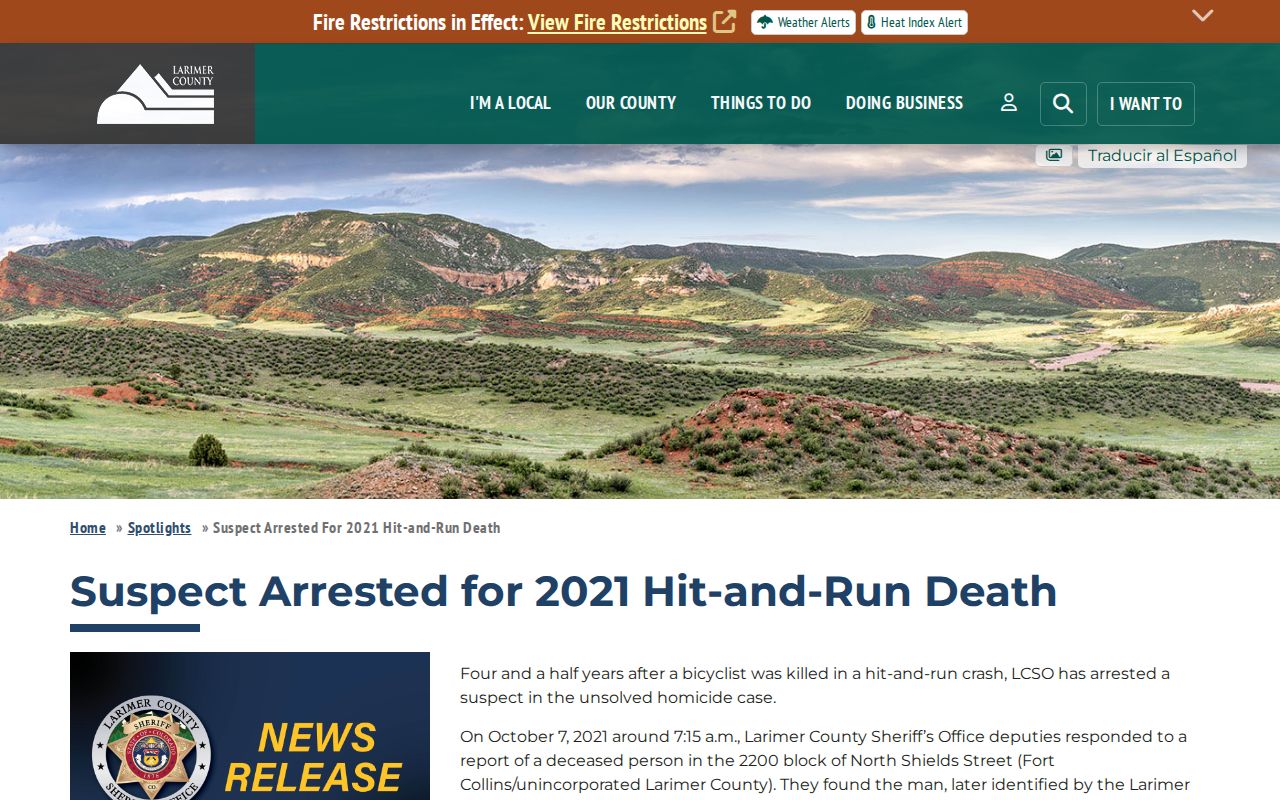
That path is different from a bench warrant for missed court, so the issuing court and warrant reason should be checked before drawing conclusions.
Restricted Larimer Charge Records
Not all arrest and charge information is public. Juvenile delinquency records are commonly restricted and may be expunged in eligible cases. Sealing under C.R.S. section 24-72-701 et seq. can hide eligible adult criminal records from public view while preserving access for courts, law enforcement, prosecutors, and other authorized users. Suppressed cases, protected-party information, medical facts, financial identifiers, victim details, and minors' names can be redacted or withheld.
| Process | Public effect | Important limit |
|---|---|---|
| Sealing | Restricts public access to eligible records | Authorized agencies may still see the record |
| Juvenile expungement | Removes or restricts eligible juvenile delinquency records | Rules differ from adult sealing |
| Redaction | Hides protected facts in an otherwise public file | The case may remain visible |
Important: Public charge records should not be used as proof of conviction without checking the final court disposition.